Arguments for the Viability of a Market in
Internet Video
Given the problems outlined above, for online video
to emerge as a viable business there must be powerful drivers for growth in the
sector. It has been noted above that there is empirical evidence that services
such as BBC iPlayer and Netflix are experiencing very impressive growth and the
establishment of a wide variety of competing services indicate that businesses
are seeking to exploit an improving market. Developments within the last few years
do provide evidence that there are reasons why there should be a healthy
increase in both provision and usage of a wide range of video content online.
Some drivers are purely pragmatic – principally the need for major film studios
to locate new revenue stream to replace declining DVD sales – but some are
intrinsic to the nature of the medium itself.
Documentary
A number of online video sites specialise in
documentary film. In the UK sites such as joiningthedocs, Insight News TV and
Brightwide provide access to short and feature-length documentaries through a
mixture of free, individual payment and subscription models. The sites share a
common aim – providing access to filmmakers who may find difficulty in getting
their work seen through traditional channels:
The films are made by a passionate, international group of socially
committed people who have a mission to try and make sense of the world. They
illuminate our times and help to support a fully-functioning society. But they
are hard to see. Although some are shown by public service and public-minded TV
broadcasters, they tend to be on specialist channels, in the corners of
schedules and rarely repeated.
Many films play at international
festivals, and on occasion are theatrically released. But how often have you
read a great review of a film and then not had the chance to watch it? We know
that audiences expect to find what they want, when they want, at a time and
price that suits them. That’s where joiningthedocs.tv comes in.[1]

Sites such as these seek to exploit the geographical and social
reach of the internet to bring niche content to audiences who may be too small,
dispersed and difficult to market to for traditional theatrical, broadcast and
packaged home media businesses. They provide the same function as film
festivals in that they bring together viewers with a particular interest, but
do so without the time and place limitations. However, this does mean that they
miss out on the marketing push that generally accompanies a physical festival
and – perhaps as a result – many of these partner with established film
festivals to provide access to individual films and series screening at a
festival, while gaining some much needed exposure. In this way joiningthedocs
has screened films from the Sheffield Documentary Film Festival, whilst Mubi
screens films in conjuntion with major film festivals such as Cannes.
.png)
While such
ventures are ultimately commercial, the stated aims of broadening the range of
voices available to film viewers is recognised in a number of partnerships and
grants which allow these businesses to operate in challenging commercial
environments. Joiningthedocs, Mubi, Curzon and Brightwide are supported by the
EU's MEDIA Programme – a funding body which operates across the full spectrum
of the media industry in Europe to encourage and support the production and
distribution of audio/visual arts. The Programme's "Video on Demand and
Digital Cinema Distribution" stream
... [is] one of the ways in
which the MEDIA 2007 programme ensures that the latest technologies and trends
are incorporated into the business practices of beneficiaries of the programme.
Digital technologies have made European audiovisual works more easily
accessible outside their country of origin thanks to new ways of transporting
audiovisual content. The competitiveness of the audiovisual content industry in
Europe will strongly depend on the use of these new technologies at the
distribution stage. [2]
The Programme has provided grants of up to 50% and £1 million to
UK projects operating in the digital screening and distribution sphere, for
European works deemed to have a social or artistic merit. This illustrates that
governments are beginning to support online video businesses as a cost
effective means of promoting local and independently-produced video works,
which may otherwise struggle for distribution in an industry dominated by
Hollywood narrative feature-length works.
Despite this,
it should be noted that mainstream online video businesses also carry a
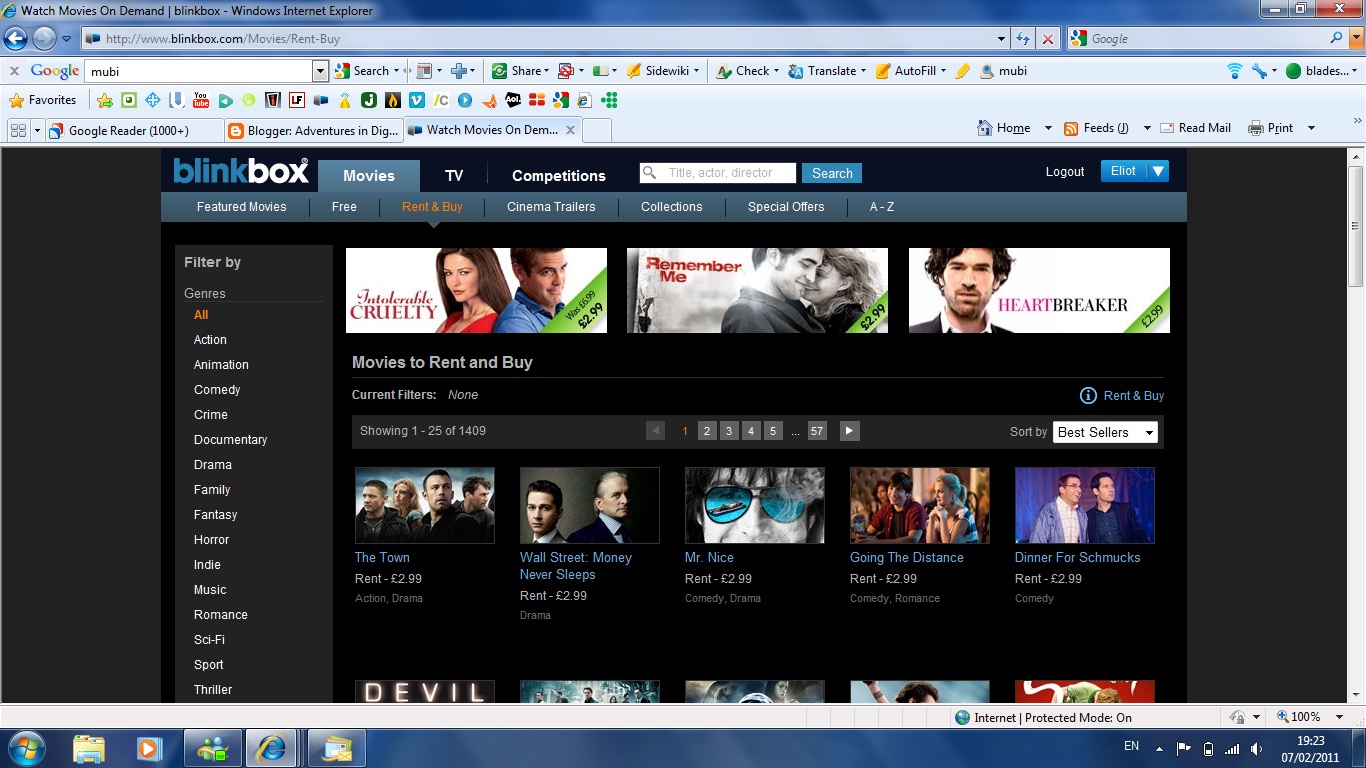
substantial amount of documentary content. Both Lovefilm and Blinkbox are
mainstream, commercial online video businesses in the UK market, who provide
access to dozens of documentary works from around the world. This reflects the
recent resurgance of popularity in documentary film, primarily through the work
of Morgan Spurlock, Nick Broomfield and Michael Moore, each of whose work is
found in their catalogues. However, they also exhibit a series of low-budget,
locally produced documentaries. Though it could be argued that some of these
works are an example of cheap library content which is used to bulk up the
numbers of titles offered, online video businesses are at least providing
access to documentary filmmakers who may struggle to have works discovered on
television or packaged media.
Niche Content

Compared to the traditional
retail market for packaged media, the internet presents multiple opportunities
to target marketing to specific groups. This kind of direct marketing is not
new – Odeon Entertainment is one several UK companies who rely on distribution
of traditional mail order catalogues to appeal directly to the mature customer
who may not use the internet or who would not normally shop in traditional DVD
outlets such as HMV. In this way, Odeon can target the kind of customer to whom
its catalogue – largely classic British film from the post-war years – directly
appeals.
Though the recent decline in the
retail market for packaged media (and decline in retail in general) is a
regrettable reduction in sales opportunity for film companies, internet
marketing does provide opportunity to push titles who may have previously
struggled on shop shelves. To walk into a store such as HMV on Oxford Street,
the consumer may be overwhelmed by the range of titles on offer. Even in more
modest high street outlets, the traditional alphabetical ordering of titles and
shelf-stacking may mean that niche titles from small companies get lost in
preference to free-standing displays and other premium marketing tools
exploited by Hollywood studios. Small UK companies have had some success in
this market by exploiting branding and packaging to stand out on the crowded
shelves. Salvation is a small distributor who sells a small catalogue of
obscure 60s and 70s European horror films. Nigel Wingrove, the company’s CEO
and a former art director, used a single, stark black-and-white sleeve design
for his titles – alongside striking photographic cover images – and instructed
retailers to place them together on shelves. He also numbered the titles and
included full catalogues in each VHS box to encourage purchasers to collect
other titles[3].
This strategy worked brilliantly, allowing a small start-up distributor to
become one of the independent stars of the late 90s sell through industry.

The ability to develop a brand
identity and to present it as close to the retail point as possible is one of
the positive features of internet marketing. Salvation has carried its unique
design through VHS and DVD box art into its website and associated online
ventures. It has also provided imagery which has been used in special
promotions by online DVD retailers such as Play.com. Consumers are alerted to
titles which may interest them through the use of recommendation algorithms
used by online retailers. Using metadata extracted from titles which consumers
have previously purchased – principally information such as genre, stars,
directors, etc – retailers recommend titles within the webpage when consumers
log on, or via email. Film
distributors also utilise the internet to market titles by engaging with
message boards which are relevant to the type of content they supply.
Cult-Labs.com is a message board set up by a small group of UK-based distributors
of niche art house and exploitation film features. By directly engaging with
customers and – in some cases, even directly involving them in production –
these companies encourage brand loyalty and build-in a support base which
allows them to securely release titles major companies would view as a
financial risk. Shameless Screen Entertainment – one of the companies operating
under the Cult Labs banner – has released several “Fan edition” titles, which
contain text and audio commentaries from fans that have expert knowledge of a
film and its production history[4].
The Online Market for “Library Content”
Titles from Salvation, Shameless
and Arrow Video are released on physical formats such as DVD, but over the last
few years almost all titles have been licensed for streaming or download on
online video sites. In the UK, the most lucrative sources of online licensing
revenue for film distributors have been Lovefilm and iTunes. Titles have also
been licensed for other territories, with the US market proving most mature to
date. A number of different licensing models have been used[5]:
- Single payment. A single fee is paid by
the licensor for the rights to stream or serve downloads to viewers
- Single payment plus royalties. A single,
upfront payment is made for online rights. In addition, should the content
prove lucrative beyond an agreed figure (for example, number of views); a
further payment – often a percentage of expected revenue – will be made.
- Royalty only. The licensor does not make
any upfront payment for the online rights. Instead, payments are made
dependent on performance.
- Royalty with minimum reserve fee. This is
similar to 3, with the protection that the licensor will agree to make a
minimum payment, regardless of the performance of the content.
Each licensing payment
model can be applied to these further categories:
- Per-title license. The licensor deals
with the distributor on a title-by-title basis, agreeing differing terms
dependent on expected revenue, or differences in how a title will be made
available (i.e. streaming or download, part of free promotion, etc.)
- Packaged. A number of titles from an
individual distributor are sold as a group. This is the most common
arrangement for niche, library and non-mainstream content.
- Exclusive. The content (single title or
package) is licensed on an exclusive basis to the licensor. The
distributor is prevented from licensing the content to another online
video provider for the duration of the agreement.
- Non-exclusive. The inverse of 3 – the
licensee retains the right to make deals with other online video
providers.
- Time-limited. The content is licensed for
a specific period – with rights expiring at the end. This is often used in
conjunction with exclusive rights deals – giving a licensor the sole rights
to provide the content for a defined period.
- Perpetual. Rights are granted to make
video content available in perpetuity. This is rare and will usually only
be granted under special circumstances – i.e. with low-value content, or
for charitable use, etc.
So, we see a number of
titles from the above companies available in different formats – streaming and
download – on different online video sites, in cases where rights have been
negotiated on a non-exclusive basis. Less well-established services attempt to
negotiate royalty-only licensing deals with distributors, while – in most
cases, at the current time – rights holders have been keen to gain some form of
guaranteed payment up front. Distributors tend to view such royalty only deals
as giving away product to what are, in effect, internet start-up companies.
This does tend to lead to a situation where small internet video companies –
such as Channel Films – concentrate, at least in the short term, on a small
library of niche content. The alternative is to try and obtain funding to pay
for a mainstream catalogue, something which is proving extremely difficult in
the current economic climate. Competing with mainstream players for Hollywood
film content requires “very deep pockets”[6].

In some cases, an initial
licensing offer from an online video business has been viewed as an unforeseen
windfall for small distributors. Some distributors have been unaware of the
opportunities presented by online video business and have not considered
actively pursuing licensing deals. This may be so for a number of reasons –
from a lack of understanding of current market trends or a concern over the
potential costs of preparing content for online distribution. While many
companies have already prepared digital masters of titles for DVD distribution,
online distribution requires a number of different digital file formats be made
available – a process which can be costly. A number of companies – including
ContentFilm and The Associates – act as Film Aggregators in the online video
sphere. This means that they operate as enablers between small, independent
distributors and producers and major online businesses such as Lovefilm.
Aggregators will generally offer a small company a one-off license fee for a
package of titles for an agreed number of years. They will often take care of
remasters the titles and formatting them for digital distribution. They will
then package these titles in a way which is attractive for online video
retailers. Companies such as
ContentFilm have developed considerable experience in the market for online
feature-length video and will be able to maximise the value inherent in
independently-produced titles.
Distribution of Independent and Low-Budget
Film

Online video has matured to the point where it represents
not just a platform for redistributing and exhibiting features made for
theatrical and DVD release, but is a viable primary release target for film
content. In addition to working in the film aggregation sphere, ContentFilm
develops original film and television productions for exhibition on the
internet. The company's Fireworks International division produces a number of
titles in dual-format for exhibition either as a series of short-form episodes
(or webisodes, as they are sometimes referred to) or as feature-length. It has
produced content which has been shown on websites run by major US television
networks and by The Horror Channel cable channel in the UK. Titles are often
subsequently issued on DVD, but they are targeted and tailored for the online
market. Companies like this are developing a new market for low-budget, digital
film content which will allow a new breed of filmmakers a viable commercial
opportunity to make work which will be sold and seen. While film school
graduates have been torn between the extremes of non-commercial short films for
exhibition at festivals and non-narrative work in advertising, short-form
content production for the internet marketplace presents a real opportunity to
develop new filmmaking voices from the current generation.
In addition to the opportunities presented by such
companies as ContentFilm, the internet and digital filmmaking in general have
allowed costs in all areas of film production to be lowered. This enables
independent film makers and producers to take advantage of low barriers to
entry to get low-budget features made and seen. A large number of websites
offer support services to independent film makers, allowing them to recruit
production staff, obtain equipment and identify locations by taking advantage
of like-minded individuals across the country. The wider fan network across
forums and film sites allows film makers to build word of mouth and maintain
interest in forthcoming productions – whether they are being made available for
free streaming, release on self-produced DVD or appearing at a film festival.
The immediacy of feedback from promotional tools such as Youtube trailers also
allows filmmakers to gauge potential audience reaction before an expensive and
irreversible final release takes place. The internet has also broadened
opportunity for filmmakers to seek finance, with a number of crowd-sourcing
funding services emerging.
Social Media
One of the primary internet resources for marketing
is Facebook and films of all budgets are increasingly exploiting the
opportunities provided by social networking services to generate exposure for
forthcoming productions. Most productions will set up a Facebook page (in
addition to a generic web page) before filming takes place, often before a film
has even secured its budget. This page can then be used a central point to
publish information about the film, to interested users who have “liked” the
page – and in turn contributed to promoting the film, as all “likes” are
displayed on user's own Facebook pages. The pages can be used to issue calls
for funding, equipment, locations and extras. They can be used to publish
promotional videos and images. Interested users can post messages of support or
critiques of the film. The pages can be linked with other pages to form
networks of support and mutual promotion for other films and filmmakers.

Social media tools are also becoming increasingly
embedded in online video viewing platforms. These allow viewers to easily tag
which videos they are watching, allowing them to comment on films as they watch
them and participate in a global conversation – in real-time – with others
viewing the same content. Such activities, while fun and potentially rewarding
for the user, have real value for online video businesses as it allows them to
build a profile of their viewers – their likes and dislikes, the way that the
watch content (for example, whether viewing is regularly interrupted, whether
content is watched in groups) , etc. Social media services such as Facebook and
Twitter, who are collating such data, are becoming valuable resources for
business. They allow information about a user to be utilised to more carefully
target advertising and other service offerings[7].
Though there are real concerns around issues of data protection and invasion of
privacy, the opportunities to more accurately market goods and services to
consumers should be a positive thing for viewers of online video, who may be
forced to view a number of adverts pre- and during some ad-supported film content.
For companies such as Netflix, Lovefilm and Blinkbox, convincing advertisers of
the efficiency of their advertising model can only increase revenue, and allow
them to secure better content and improve service levels for viewers. In an
ideal world, such activity can only benefit all stakeholders in online video.
Connected Devices
As was outlined above, one of the main impediments to
the widespread adoption of online video is the perceived and real usability
issues. However, as households have gained access to increased broadband
speeds, a new breed of devices have come to market which seek to bring internet
services – and online video in particular – closer to the family screen. These
devices – connected TV, bluray players, media players and hybrid set-top boxes
– seek to shift the public perception of online video from something which is
free, low-quality and short-form, to that which is of value, pleasing to the
eye and feature-length. Though a number of these devices provide access to
Youtube, the kinds of experiences they aspire to offer are closer to
pay-per-view cable, DVD or a theatrical screening. Connected Television – sets
which can be plugged into a home internet router to access online services –
are seen by many as the killer application for online video. However, some have
pointed out that “there's precious little research that proves that connected
TV buyers are actually using those sets to access significant amounts of
content online.”[8] Despite
this, all major television manufacturers are releasing connected sets[9].
In short, the audio-visual electronics industry is invested in making online
video something worth paying for.

The clearest example of this phenomenon is the
development of a number of televisions and bluray players in the US with remote
controls containing a “Netflix” button. It seems incredible that a single
company could gain such levels of free exposure and access from hardware
manufacturers without entering into an expensive commercial agreement, but this
initiative has been led by the electronics companies. In adding the Netflix
button they are acknowledging, not just the considerable success that the
company has had in building a large subscriber base and the attractiveness of
its offering, but the importance of online video to TV viewing in the future.
In much the same way that manufacturers built hybrids TV/VHS remotes in the
past, these companies are modifying devices to reflect an emerging reality,
that their customers will be spending a considerable portion of their time with
such devices online. The majority of all new televisions has an Ethernet
connection and contains electronics capable of displaying a simple series of
menus allowing remote control access to online services. These services extend
from simple applications displaying weather and local news to social media
applications such as Twitter, but a large proportion are front-ends for the
growing number of online video services.
It’s worth examining whether such video offerings
simply allow the viewer to cancel their cable subscription (so-called
“cable-cutting”, a nightmare for the pay TV industry), or whether the nature of
the medium offers something more for viewers, distributors and filmmakers.
Connected devices do have the potential to offer a greater range of content
than traditional cable and satellite offerings. To begin with, as the devices
are built by consumer electronics companies, they operate as portals to an
online marketplace, rather than the box-office for a media company's film and
television offering. Though a company such as Sky obviously has to share
revenue with rights holders, it controls every aspect of the delivery of film
content to viewers and collects all revenue directly at source (through
subscription and on demand payments). Companies such as Samsung, who offer a
multitude of video services through its Smart TV series of connected
televisions, do not actually have any involvement in the provisioning or
billing for film content. When a customer pays for a film from the Acetrax
service, he or she has their credit card debiting by Acetrax, who then stream
the film to the Smart TV through the open internet. The device simply enables
the transaction; it does not mediate it in any way. In many respects, despite
the sofa-friendly interface, the model of video provisioning used by connected
media devices for the lounge, is the same as that for services used on personal
computers. Video services operating in this way are said to be “Over-the-top”
or OTT – they reach over or bypass the networks and services which traditional
broadcasters have developed to supply media content.
Catch-up Services
One of the major factors which
has normalised the viewing of online video in the UK has been so-called
“catch-up” video services from traditional broadcasters. Each of the UK’s
terrestrial broadcasters – the BBC, ITV, Channel 4 and Channel 5 – maintains
web- and application- based services allowing viewers to watch content recently
broadcast, including feature films. The first broadcaster to launch such a
service was the BBC, who has used their public service mandate to justify
substantial investment in the service. Initially only available on personal
computers, the service proved an immediate hit with viewers – allowing them to
download a range of programmes broadcast on the corporation’s channels within
the previous seven days. The
BBC has heavily promoted the service on its channels, with most adverts for
upcoming programmes and series also stating that they are “also available on
BBC iPlayer”. The service has been continuously enhanced since release and now
offers an incredibly rich range of programmes and has a very useable interface.
The service has also been available on a plethora of connected devices –
everything from tablet computers, mobile phones, bluray players, set-top boxes
to connected TVs are now to be found with the iPlayer app either pre-installed
or readily available from the device’s relevant application marketplace. The
BBC has agreed to only implement the standard iPlayer across each device, to
ensure that their public-service brief is not impacted by any perception of
providing an enhanced service to any commercial device.

Initially operating as a
download-only service for PC, iPlayer is now primarily a streaming service.
This works, in conjunction with a user-interface which mimics a standard TV
Electronic Programme Guide (EPG), to bring the viewing of online video into
line with the user experience of broadcast television. The fact that the
content is being streamed from remote servers, over the open internet, is
abstracted from the user by the interface. [MENTION IPLAYER DESKTOP PVR].
Services from the other broadcasters have mimicked iPlayer (ITV’s service is
even called ITV Player and Sky’s catch-up service was initially called Sky
Player), arranging the user interface along the same EPG-like lines.
Manufacturers of connected TVs and hybrid set-top boxes (cable, satellite or
digital terrestrial receivers with internet connections) have incorporated
catch-up services into the standard EPG, allowing users to move back through
the schedule and view identify which programmes they may have missed which are
available on catch-up services. Advanced search functionality has also been
developed – with Virgin Media's TiVo system “viewers can search across TV
listings, seven-day catch-up, on-demand, favourite actors, future shows and
online content all with one simple search.”[10]
Such functionality obviates the need for PVR/DVR technology as viewers no
longer need to record programmes – such content is stored by broadcasters for
playback over connected devices in the home. Though the range of film content
carried on such services was initially limited – films, as with other content
which is produced by external companies, must be separately licensed for online
delivery – services such as the iPlayer now carry up to 10 films from its
recent schedule for playback at any time. Broadcasters are, in this way,
maintaining their own on-demand film library.
Cloud Services
Another technological development
which is driving the adoption of online video is cloud storage. The cloud
refers to an abstracted collection of remote servers which store and serve
physical files to client devices, across the internet. A number of services
have been recently established which allow users to store a multitude of
different file types on remote storage, from which it can be accessed from a
different machine, potentially in a different location. This kind of technology
is very useful in business where it can enable groups of
geographically-dispersed employees to work concurrently on single pieces of
work.
In the media space
this kind of technology is being leveraged to enable the delivery of paid-for
content to multiple client devices in the home and on the move.
Film studios and other media
organisations have been waking up to the fact that consumers are averse to DRM
- in particular, they hate the way that it restricts the portability of
legally-purchased content. Persuading consumers that they should shun piracy has
been made very difficult by the sorts of restrictions which mean that a film,
ordered and paid for on one device, is restricted to playback on that device
alone, or can only be moved a fixed amount of times under extremely
prescriptive circumstances. In a shared or family home, where use of a TV and
STB or bluray player in the lounge might be restricted to certain times of the
day, content purchased on these machines should be playable on any device in
any room in the home. This has not been the case with traditional on demand
entertainment platforms, where a film is requested and played-back on a single
host device (a set-top box), usually connected to a single display.

Expanding this concept, it would
be an even more enticing proposition if the content was viewable outside the
home - so that, for example, a children's film purchased on a net TV could be
taken to a relative’s home. Where content is purchased for rental, there will
still be time restrictions on viewing. Where the cloud storage and delivery
proposition is more compelling is in cases of outright purchase. Content owners
have struggled to convince consumers on outright purchase of digital content -
especially film. Rental of such content currently outweighs purchase by a
margin of 4-to-1. The issues holding back purchase have included these very
issues - the restrictions of DRM, the intangibility of the product itself, poor
perception of price value compared to physical media, concerns over storage. It
is these issues which cloud storage and delivery is designed to resolve.
Services which are emerging which utilise cloud storage and delivery of video
media include "TV Everywhere", "Ultra Violet" and
"Studio All Access" - branded solutions offered by Comcast, the
Digital Entertainment Content Ecosystem and Disney, respectively. Each of these
offer the kind of remote hosting and access described above.
Comcast's solution allows cable
TV subscribers the ability to access programs from their package online through
a web portal, with plans to spread access to other devices, allowing access
throughout the home and beyond. Ultraviolet offers a solution for purchased
content from a number of sources - from VoD services to packaged DVDs purchased
at retail. Such content comes with a code which allows the content to be
accessed remotely from a number of registered devices. Content purchased
outright is stored remotely in a kind of "digital locker" or
"shelf" where the user can build his own library of content, freeing
up shelf space at home. This is also the kind of service being developed by a
number of traditional VoD and PPV download services. Acetrax, who run movie
portals on a number of connected TVs and bluray players in the UK and Europe,
allow users to register their home devices and access the same content on any
of them. DivX also use this model - allowing downloaded content to be played
via an access code entered into any DivX registered device. The concern has to
be that the number of services being offered have limited or no
interoperability - that your DivX-enabled DVD player may not be Ultra Violet
capable and vice versa. It seems that content owners are still reluctant to
embrace a true, open model - although Ultra Violet has a large number of
members and the potential to succeed as a model for the controlled, managed
method of access for hosted video content in the multi-screen home.
In any case, such developments
are in their early stages and are proceeding with an evolving sense of what
television – or home viewing in general – actually is:
…
this reshaping involves not only our relationship with the TV set as a
standalone device, but also the ways in which it can interact with other
devices and various content sources to engage us in new and innovative ways,
and the reality that a TV experience need no longer actually involve the TV
set, or may include the TV set in combination with other devices.[11]
The primacy of the
television in home viewing is being challenged, but still maintains for many
households a central role. For families especially, the main set in the family
room remains important in the function it plays in enabling the family to
experience entertainment together in one place. Despite the spread of devices
and services which enable us to experience content wherever we are, content
providers remain as focused on ensuring that there are ways they can gain
access to the primary family screen.
[3] Information from interview with Nigel
Wingrove.
[4] The full Shamless collection on Cult Labs
website - http://www.cult-labs.com/forums/shameless-collection/4738-full-shameless-collection.html
[5] Details of licensing deals for online
content taken from interviews with Alex Agran, Tom Swanston, Nigel Wingrove and
Jonathan Ford.
[6] "Will streaming Tv online lead to the
death of the big media players", Jemima Kiss, The Guardian, 18 April 2011.
http://www.guardian.co.uk/media/2011/apr/18/digital-video-streaming-online-netflix
[7] "Private Facebook data becomes big
business", Tony Bradley, PC World, 30 Jul 2010. http://www.pcworld.com/businesscenter/article/202285/private_facebook_data_becomes_big_business.html
[8] "The Television will not be
revolutionised", Eric Schumacher-Rasmussen in Streaming Media Magazine
European Edition, Autumn 2011, p. 8
[9] "More customers than not are connecting
their television to their internet connection." Interview with Edd Uzzell.
[10] "Power to the People", Graham
Pomphrey, in Digital TV Europe, September/October 2011, p.17
[11] "IPTV – the future", Yun Chao Hu in
Connect-World Europe, 2001, p. 13